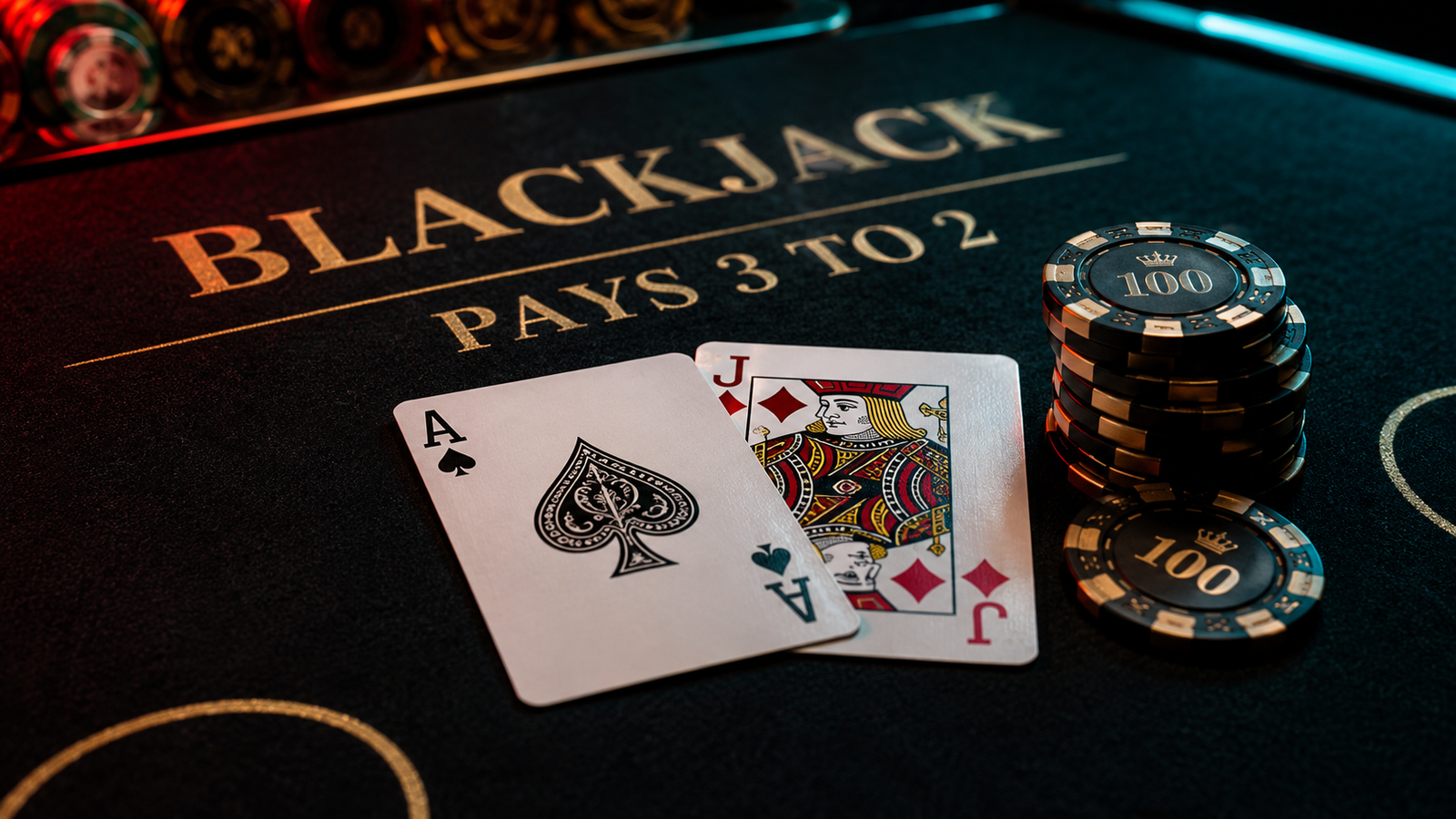
Direct Answer: 3:2 blackjack means the casino pays you \$3 for every \$2 wagered (a 1.5x payout or +150% profit) whenever you are dealt a natural 21 (Ace + 10-value card). In contrast, modern casinos increasingly offer 6:5 tables (paying only \$1.20 per dollar), which stealthily increases the house edge by +1.39%.
When sitting down at a blackjack table, most players pay attention to the minimum bet limit and the number of decks. However, the single most impactful sentence printed on the table felt is often overlooked: "Blackjack Pays 3 to 2" vs. "Blackjack Pays 6 to 5".
Understanding this payout distinction is the foundational rule of smart casino bankroll management. Here is the mathematical breakdown of how 3:2 payouts work, why 6:5 is an aggressive player trap, and how much money it costs you per hour.
1. The Payout Formula: How 3:2 Math Works
A "natural blackjack" occurs when your initial two cards total 21. On a standard 3:2 table, your payout is calculated as follows:
Payout = (Bet Amount × 3) / 2 = Bet Amount × 1.5Compare the actual dollar difference between 3:2 and 6:5 across various bet sizes:
| Bet Size | 3:2 Payout (Fair Table) | 6:5 Payout (Tourist Trap) | Loss Per Natural 21 |
|---|---|---|---|
| \$10 Bet | \$15.00 | \$12.00 | -\$3.00 |
| \$25 Bet | \$37.50 | \$30.00 | -\$7.50 |
| \$50 Bet | \$75.00 | \$60.00 | -\$15.00 |
| \$100 Bet | \$150.00 | \$120.00 | -\$30.00 |
2. The Mathematical Impact on House Edge
A standard 6-deck shoe with fair rules (Dealer Stands on Soft 17, Double After Split allowed) has a baseline house edge of approximately 0.58% against a basic strategy player.
When a casino changes that exact table from 3:2 to 6:5:
- The house edge surges by +1.39%.
- The total house advantage jumps from 0.58% to 1.97%.
- The casino's statistical advantage over you is multiplied by more than 3.4x overnight.
Even if you play a double-deck blackjack game with fewer cards, playing under 6:5 rules completely destroys your mathematical advantage.
3. Expected Hourly Loss: 3:2 vs. 6:5 Simulation
Assuming an average pace of 70 hands per hour with an average bet of \$25 per hand (total \$1,750 wagered per hour):
| Table Payout | Total House Edge | Expected Loss Per Hour | Expected Loss (4-Hour Session) |
|---|---|---|---|
| 3:2 Blackjack | 0.58% | \$10.15 / hr | \$40.60 |
| 6:5 Blackjack | 1.97% | \$34.48 / hr | \$137.92 |
Over a standard weekend trip (12 hours of play), sitting at a 6:5 table costs a \$25 bettor an extra \$292.00 in pure mathematical bleed.
4. How to Spot 6:5 Tables Before Sitting Down
- Look at the Felt Imprint: Regulated casinos are legally required to print the payout in bold lettering across the center felt (e.g., "Blackjack Pays 3 to 2").
- Check the Minimums: In Las Vegas and Atlantic City, 6:5 tables are heavily concentrated in low-limit pits (\$10–\$15 tables) and party pits with loud music.
- Electronic & Stadium Tables: Always check the digital rule placard on automated dealer screens, where 6:5 is frequently defaulted.
Frequently Asked Questions
Is 6:5 ever worth playing if the minimum bet is lower?
No. It is always mathematically better to play a \$25 minimum 3:2 table with strict bankroll limits than to grind away at a \$10 6:5 table where the house edge is nearly 2%.
Can basic strategy beat a 6:5 blackjack game?
No basic strategy or betting progression system can overcome a 1.97% house edge. Basic strategy only minimizes losses; it cannot make a negative expectation (-EV) game profitable.
What about tables that pay 1:1 (Even Money) for blackjack?
Never play 1:1 tables. Even money on natural blackjacks adds an catastrophic +2.27% to the house edge, turning blackjack into one of the worst bets on the casino floor.
Summary Key Takeaways
- 3:2 tables pay \$1.50 profit per dollar bet on natural blackjacks; 6:5 tables pay only \$1.20.
- A 6:5 payout increases the casino's house edge from ~0.58% to 1.97%.
- Always inspect the table felt before making your initial buy-in.