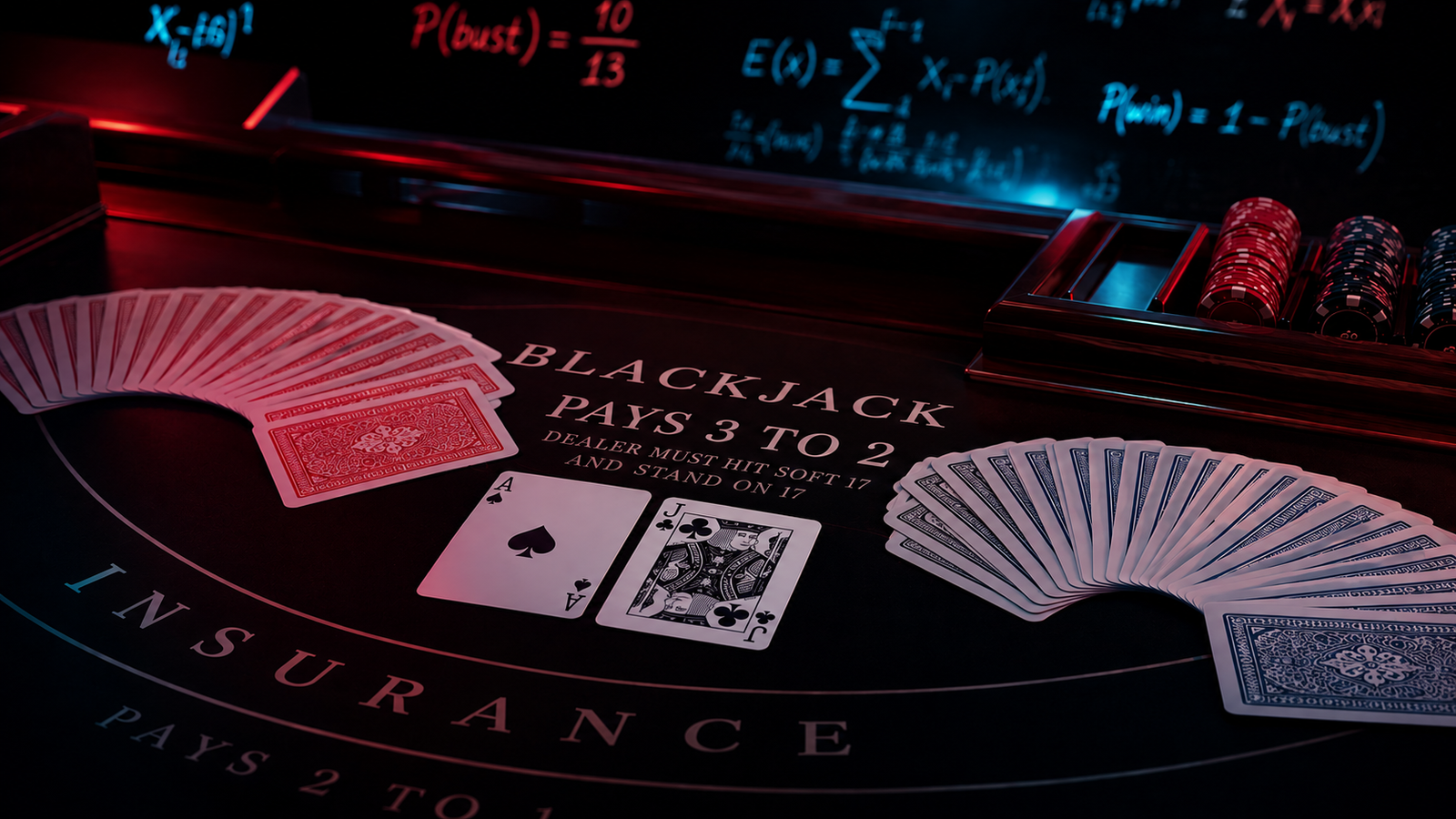
Direct Answer: Mathematically, yes—fewer decks reduce the house edge by approximately 0.18% to 0.40% because natural blackjacks occur more frequently and doubling down is more potent. However, double-deck games are only better if the casino maintains standard 3:2 payouts. If the table pays 6:5, a standard 6-deck shoe is vastly superior.
Walk through any casino pit, and you will notice that double-deck blackjack tables often have higher minimum bets and attract more experienced players. But is playing with two decks genuinely better for your bankroll, or is it a psychological illusion?
To answer this, we must examine the mathematical baseline of deck quantity, how shoe composition impacts basic strategy, and the deceptive rule traps casinos use to reclaim their advantage.
1. The Raw Deck Mathematics: 2 Decks vs. 6 Decks
Assuming all other table rules remain identical (such as Dealer Stands on Soft 17 and Double After Split is allowed), the number of decks used directly alters the mathematical house edge:
| Shoe Structure | Baseline House Edge | Player Advantage vs. 8 Decks |
|---|---|---|
| Single Deck (1 Deck / 52 Cards) | 0.17% | +0.49% (Best) |
| Double Deck (2 Decks / 104 Cards) | 0.46% | +0.20% Advantage |
| Four Decks (4 Decks / 208 Cards) | 0.60% | +0.06% |
| Six Decks (6 Decks / 312 Cards) | 0.64% | Baseline Shoe |
| Eight Decks (8 Decks / 416 Cards) | 0.66% | -0.02% (Worst) |
2. Why Fewer Decks Mathematically Favor the Player
The math behind the double-deck advantage comes down to two statistical factors: blackjack frequency and card removal effect.
A. Higher Natural Blackjack Probability
A natural blackjack requires an Ace and a 10-value card (10, J, Q, K). The combinatorial probability formula for a natural blackjack is:
P(Blackjack) = 2 × (Number of Aces / Total Cards) × (Number of Tens / (Total Cards - 1))
In a 2-deck game (104 cards): P(BJ) = 2 × (8/104) × (32/103) = 4.782% (1 in every 20.91 hands).
In a 6-deck shoe (312 cards): P(BJ) = 2 × (24/312) × (96/311) = 4.745% (1 in every 21.07 hands).
Over thousands of rounds, this mathematical difference yields significantly more 3:2 bonus payouts in a double-deck game.
B. Increased Potency of Double Downs
When you double down on an 11 or 10, you want a 10-value card. In a double-deck game, removing non-ten cards during the deal has a proportionally larger impact on concentrating the remaining high cards in the shoe, increasing your double-down conversion rate.
3. The "Double Deck Trap": Watch the Table Felt
Casinos understand the mathematics just as well as advantage players do. To neutralize the player's 0.20% edge in 2-deck games, operators often introduce restrictive table rules:
⚠️ RULE PENALTIES TO WATCH FOR:
• 6:5 Blackjack Payout: Adds +1.39% to House Edge (AVOID AT ALL COSTS)
• No Double After Split (NDAS): Adds +0.14% to House Edge
• Dealer Hits Soft 17 (H17): Adds +0.22% to House Edge
• No Resplitting Aces: Adds +0.08% to House Edge
If a casino offers a double-deck table but reduces the blackjack payout from 3:2 to 6:5, the house edge surges from 0.46% to 1.85%. That makes the game almost three times worse than a standard 6-deck shoe paying 3:2.
4. Rule Comparison: Which Table Should You Choose?
Always evaluate the entire rule set rather than looking solely at the deck count:
| Table Configuration | Blackjack Payout | Dealer Soft 17 | Total House Edge | Verdict |
|---|---|---|---|---|
| Double Deck (2 Decks) | 3:2 | Stand (S17) | 0.40% | Excellent (Play Here) |
| Standard Shoe (6 Decks) | 3:2 | Stand (S17) | 0.58% | Good (Solid Choice) |
| Double Deck (2 Decks) | 3:2 | Hit (H17) | 0.62% | Fair (Acceptable) |
| Double Deck (2 Decks) | 6:5 | Hit (H17) | 1.85% | Terrible (Walk Away) |
5. Double Deck Strategy Deviations: 4 Plays That Change
You cannot use a standard 6-deck strategy card on a 2-deck table. Because card removal has a stronger statistical weight in smaller shoes, four key basic strategy decisions change:
| Player Hand | Dealer Upcard | Standard 6-Deck Move | Double Deck (2-Deck) Move | Mathematical Rationale |
|---|---|---|---|---|
| Hard 9 | Dealer 2 | Hit | Double Down (if DAS) | Higher density of 10s gives 9 a positive EV against dealer bust card. |
| Hard 11 | Dealer Ace | Hit | Double Down (in S17) | Player conversion to 21 outweighs dealer blackjack risk in 104-card pool. |
| Soft 18 (A,7) | Dealer 2 | Stand | Double Down (if DAS) | Improves Expected Value when dealer is in a weak drawing position. |
| Pair of 7,7 | Dealer 10 | Hit | Stand (in NDAS) | Card removal reduces dealer's chance of pulling a small card to beat 14. |
6. The Cut Card Factor: Why Deck Penetration Matters
A double-deck table with great rules can still be unplayable if the casino has poor deck penetration (where the dealer places the plastic cut card):
- 50% Penetration (Poor): The dealer deals only 1 deck (52 cards) before reshuffling. This prevents favorable deck composition and neutralizes advantage play.
- 65% to 75% Penetration (Optimal): The dealer deals 65 to 75 cards before shuffling. This deep shoe penetration allows the true mathematical advantage of fewer decks to materialize.
7. Checklist Before Sitting at a Double-Deck Table
- Verify the Payout: Ensure the felt clearly states "Blackjack Pays 3 to 2". Never play a 6:5 table.
- Check Double Down Rules: Confirm that Double After Split (DAS) is permitted.
- Use a 2-Deck Basic Strategy Chart: Ensure you execute the 4 key deviations listed above.
Frequently Asked Questions
Is card counting easier in double-deck blackjack?
Yes. Because there are only 104 cards, each dealt card changes the True Count much faster than in a 6-deck shoe, allowing card counters to identify high-advantage betting opportunities earlier in the shoe with smaller bet spreads.
Why do casinos offer double deck if it favors the player?
Casinos use double-deck tables as a marketing magnet to attract high-limit players, while offsetting the lower house edge through strict table limits, shallow cut card penetration (50%), or implementing predatory 6:5 payout rules.
What is the lowest possible house edge in double-deck blackjack?
Under optimal rules (3:2 payout, Dealer Stands on Soft 17, Double After Split, Late Surrender, and Re-Splitting Aces), double-deck blackjack offers a house edge as low as 0.19% to 0.40% with perfect basic strategy.
Summary Key Takeaways
- Under identical rules, double-deck blackjack provides a ~0.20% mathematical advantage over 6-deck shoes.
- Card removal has a greater statistical impact in smaller deck pools, resulting in more natural blackjacks (4.78% vs 4.74%) and higher double-down success rates.
- Never trade deck count for payout reductions: a 6-deck 3:2 table is always superior to a 2-deck 6:5 table.