
Direct Strategy Answer
- The Golden Rule: You must HIT a hard 12 against a dealer upcard of 2 or 3, and you must STAND on a hard 12 against a dealer upcard of 4, 5, or 6. Against a 7 through Ace, you always hit.
- The Bust Rate Asymmetry: A hard 12 only busts on four card ranks (10, Jack, Queen, King), giving you a 30.77% bust risk. The remaining 69.23% of the shoe either improves your total or keeps you in the hand.
- The "Weak Upcard" Fallacy: Casual players treat a dealer 2 or 3 as a "bust card." Mathematically, a dealer showing a 2 will complete a pat hand (17 to 21) 64.6% of the time, and a 3 will complete a pat hand 62.5% of the time. Standing leaves you completely defenseless.
- The EV Margin: Hitting 12 against a 2 saves you $4.01 per $100 wagered compared to standing. Hitting against a 3 saves you $1.91 per $100 wagered.
No hand in casino gaming triggers as much table friction, hesitation, and bad advice as holding a hard 12 against a low dealer card. Sit at any blackjack table in Las Vegas, Macau, or Atlantic City, and the moment a player draws a card onto a 12 against a dealer 2 or 3, someone at the table will inevitably groan.
If the player hits, catches a face card, busts, and the dealer subsequently draws a 21, the entire table looks at third base with disgust: "Why did you hit a stiff hand? You took the dealer's bust card!"
Casual gamblers despise hitting a 12 because human psychology hates self-inflicted losses. But basic strategy is not built on emotion—it is derived from millions of Monte Carlo combinatorial iterations. Here is the mathematical truth behind the 2 vs. 3 threshold, the exact Expected Value equations, and why hitting a 12 against a 2 or 3 is non-negotiable for serious bettors.
1. The Anatomy of Hard 12: The Lowest Possible Stiff Hand
In blackjack terminology, a "stiff hand" is any hard total from 12 through 16 that can bust with a single one-card hit. However, mathematically, a 12 is vastly different from every other stiff hand on the felt.
As broken down in our analysis of whether to hit on 13 in blackjack, each incremental point above 11 rapidly expands your bust probability by exactly one full card rank (7.69% in an infinite shoe):
| Player Hand | Cards That Bust You | Bust Cards Ratio | Bust Probability | Safe Hit Probability |
|---|---|---|---|---|
| Hard 12 | 10, J, Q, K (4 ranks) | 16 / 52 | 30.77% | 69.23% |
| Hard 13 | 9, 10, J, Q, K (5 ranks) | 20 / 52 | 38.46% | 61.54% |
| Hard 14 | 8, 9, 10, J, Q, K (6 ranks) | 24 / 52 | 46.15% | 53.85% |
| Hard 15 | 7, 8, 9, 10, J, Q, K (7 ranks) | 28 / 52 | 53.85% | 46.15% |
| Hard 16 | 6, 7, 8, 9, 10, J, Q, K (8 ranks) | 32 / 52 | 61.54% | 38.46% |
Notice the massive statistical pivot: on a 12, more than two-thirds (69.23%) of all remaining cards will NOT bust your hand. If you draw an Ace, 2, 3, 4, 5, 6, 7, 8, or 9, you survive. On a 13, that safe margin drops to 61.5%, and on 14 it shrinks near an even coin flip.
Because your bust penalty on 12 is at its absolute minimum (30.8%), the optimal decision depends almost entirely on the exact strength of the dealer's upcard.
2. The "Dealer Bust Myth": Why a 2 or 3 Is NOT a 4, 5, or 6
The core reason recreational gamblers stand on 12 against a 2 or 3 is a cognitive error called category blending. Players lump cards 2 through 6 into a single mental bucket labeled "dealer bust cards."
In reality, a dealer 2 or 3 behaves very differently from a 4, 5, or 6. Examine the exact dealer final outcome probabilities across standard 6-deck games (where the dealer hits soft 17, as audited in our guide to dealer soft 17 house edge rules):
| Dealer Upcard | Dealer Bust % | Dealer Makes 17–21 | Optimal Strategy on Hard 12 |
|---|---|---|---|
| Dealer 2 | 35.35% | 64.65% | HIT |
| Dealer 3 | 37.56% | 62.44% | HIT |
| Dealer 4 | 40.28% | 59.72% | STAND |
| Dealer 5 | 42.89% | 57.11% | STAND |
| Dealer 6 | 42.08% | 57.92% | STAND |
The numbers destroy the myth:
- Why 4, 5, and 6 Warrant Standing: Against a 4, 5, or 6, the dealer’s bust probability reaches its absolute ceiling (40% to 43%). The dealer’s vulnerability is high enough that risking your 30.8% bust rate is mathematically foolish. Standing and letting the dealer self-destruct is the superior play.
- Why 2 and 3 Demand Hitting: When the dealer shows a 2, they will bust only 35.35% of the time. They will make a legitimate winning total nearly two out of every three hands (64.65%). If you stand on 12 against a 2, the only way you win is if the dealer busts. By standing, you are effectively accepting a 64.7% loss rate.
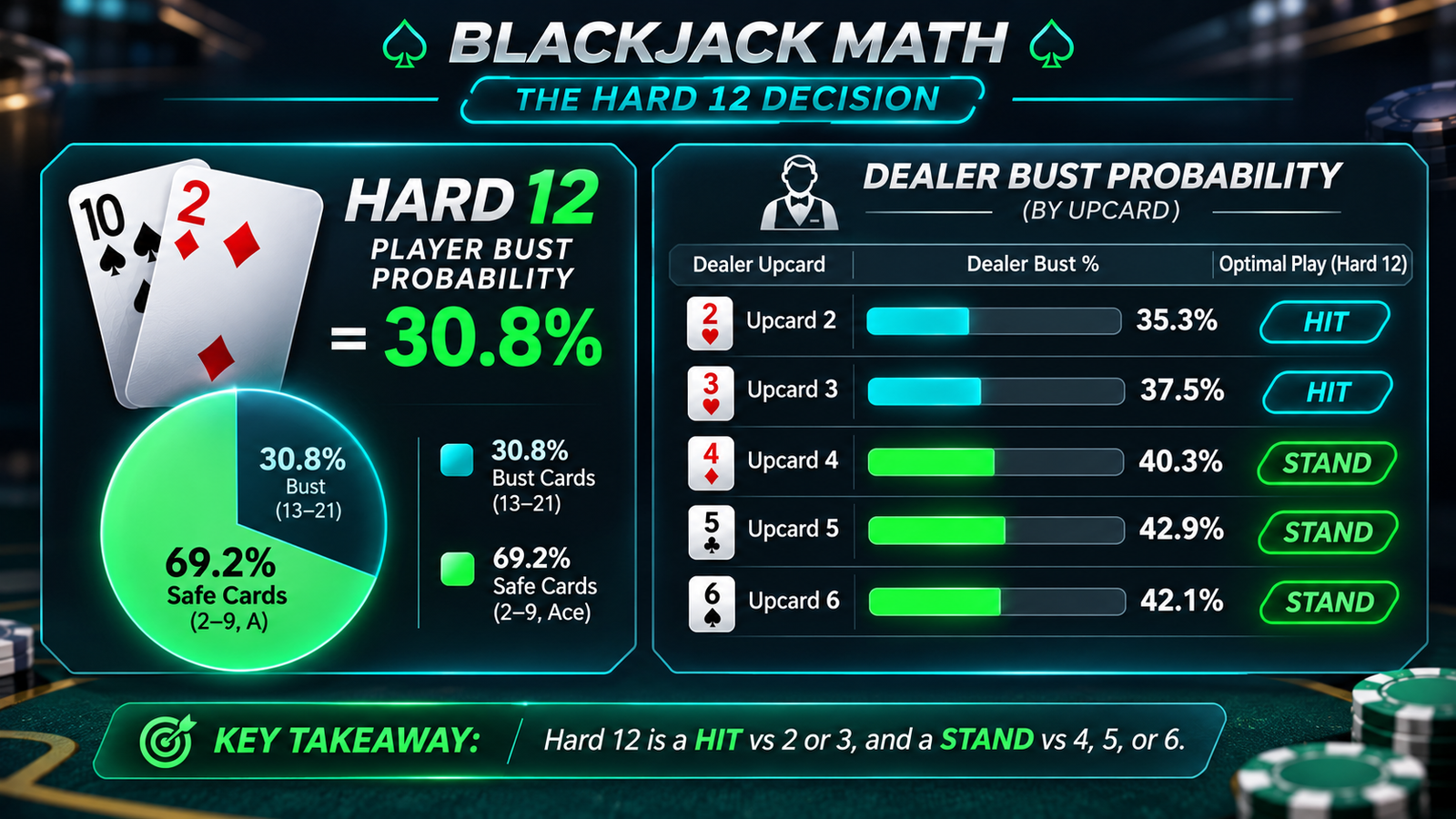
Figure 1: Player bust risk on hard 12 (30.8%) compared to dealer bust rates across upcards 2 through 6.
3. The Combinatorial EV Math: Hit vs. Stand Breakdown
In advantage blackjack math, decisions are evaluated by Expected Value ($EV$)—the average dollar amount returned per $1.00 wagered. Holding a 12 is a defensive scenario; both options carry negative expectations. Your goal is not to win every hand, but to minimize the rate of capital loss.
Here is the exact combinatorial $EV$ data for a hard 12 across a standard 6-deck shoe (calculated per $1.00 base unit):
| Scenario | EV of Standing | EV of Hitting | Correct Action | Net Financial Edge |
|---|---|---|---|---|
| Hard 12 vs. Dealer 2 | -$0.2929 | -$0.2528 | HIT | Saves +$4.01 per $100 |
| Hard 12 vs. Dealer 3 | -$0.2520 | -$0.2329 | HIT | Saves +$1.91 per $100 |
| Hard 12 vs. Dealer 4 | -$0.1837 | -$0.2010 | STAND | Saves +$1.73 per $100 |
| Hard 12 vs. Dealer 5 | -$0.1190 | -$0.1652 | STAND | Saves +$4.62 per $100 |
| Hard 12 vs. Dealer 6 | -$0.1145 | -$0.1627 | STAND | Saves +$4.82 per $100 |
Look closely at the 12 vs. 2 line: if you stand, your expected loss is -$0.2929 per dollar. If you hit, your expected loss drops to -$0.2528 per dollar. By hitting, you claw back 4.01% of equity. Over hundreds of hands, standing on 12 against a 2 is equivalent to giving the casino an extra 4% edge on every single decision.
4. Hand Composition: 10+2 vs. 8+4 vs. 6+6
Total-dependent basic strategy treats all hard 12s identically. However, serious advantage players recognize that how your 12 is built subtly changes the shoe composition:
The Three Variations of Hard 12
- The 10 + 2 Composition: You are holding a 10-value card in your hand. In single-deck or double-deck games, this removes one of the deadly bust cards from the shoe. There are now fewer 10s remaining to bust you, making hitting slightly more favorable than standard calculations indicate.
- The Multi-Card Compositions (8+4, 9+3, 7+5): These contain small cards, meaning more 10-value cards remain in the deck. While hitting remains basic strategy, your bust risk is fractionally higher than with a 10+2.
- The 6 + 6 Pair: Never hit a 6+6 as a hard 12. A pair of 6s is a Split against dealer 2, 3, 4, 5, or 6 (in standard DAS / Double After Split games). Splitting breaks a terrible 12 into two independent starting hands of 6, converting a defensive hand into an aggressive play against weak dealer cards.
5. Advantage Play Deviations: When Do Counters Stand on 12?
For basic strategy players, hitting 12 against a 2 or 3 is fixed. But for card counters tracking the deck with the Hi-Lo system (as explained in our study on online live dealer card counting mechanics), hard 12 represents one of the most important index deviations in Don Schlesinger’s Illustrious 18.
When the True Count ($TC$) rises, the remaining shoe contains a higher concentration of 10-value cards. This has two immediate mathematical consequences:
- Your probability of busting on a hit increases from 30.8% toward 38%+.
- The dealer’s probability of busting on their hidden hole card increases significantly.
As the count turns positive, standing becomes mathematically superior to hitting:
- Hard 12 vs. Dealer 2: Stand at True Count ≥ +3 (Otherwise, Hit).
- Hard 12 vs. Dealer 3: Stand at True Count ≥ +2 (Otherwise, Hit).
- Hard 12 vs. Dealer 4: Basic strategy says Stand, but Hit if True Count < 0.
- Hard 12 vs. Dealer 5: Stand, but Hit if True Count < -2.
- Hard 12 vs. Dealer 6: Stand, but Hit if True Count < -1.
Notice that unless the shoe is significantly rich in high cards ($TC \ge +3$ for a 2, or $TC \ge +2$ for a 3), basic strategy holds firm: Hit the 12.
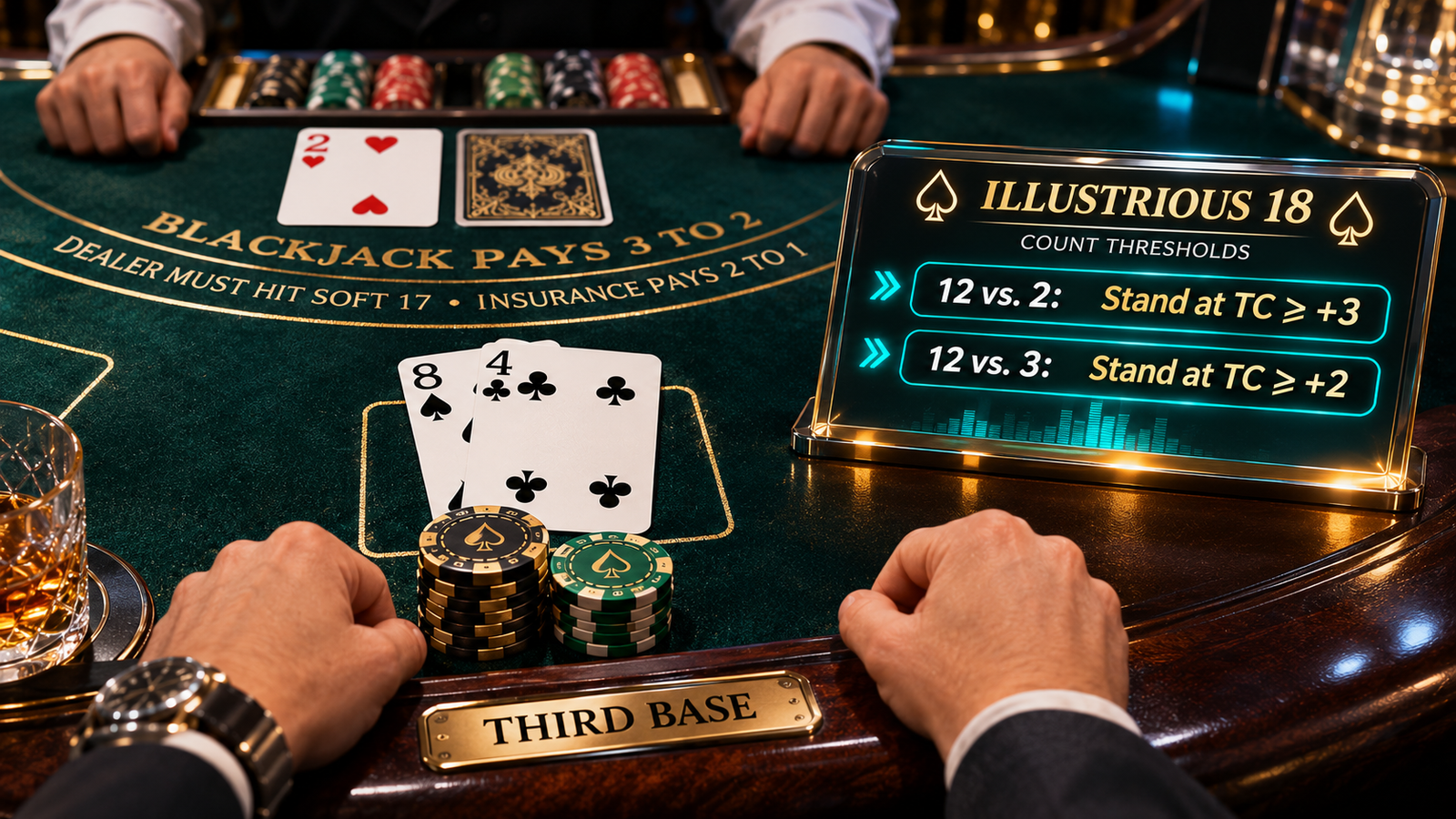
Figure 2: Illustrious 18 index deviations for hard 12, illustrating the True Count thresholds where standing becomes optimal.
6. Table Friction: The "Third Base Anchor" Fallacy
The hardest part of hitting a hard 12 against a 2 or 3 is not understanding the math—it is surviving the psychological pressure from uneducated table mates, particularly if you are sitting at "Third Base" (the anchor position, the last player to act before the dealer).
When a third-base player hits a 12 vs. 2, catches a 10, busts, and the dealer reveals a 5 (for 7 total) and draws another 10 to make 17, angry players will bark: "If you hadn't hit, that 10 would have gone to the dealer, and the dealer would have busted!"
This argument is pure cognitive bias (specifically, confirmation bias and the gambler's fallacy). Mathematicians and university researchers have proved through millions of simulated shoes that other players' hit decisions have zero statistical impact on your long-term expected return:
- The Symmetry of Unknown Cards: The next card in the shoe is completely random. When you hit, you are just as likely to take a small card that would have saved the dealer as you are to take a 10 that would have busted them.
- Selective Memory: When a hit saves the table, other players rarely thank the anchor; they view it as normal. But when a hit results in a table loss, players assign personal blame to the decision.
Never alter your basic strategy play to satisfy superstitious table mates. Over a lifetime of play, surrendering a 4% equity edge on 12 vs. 2 just to avoid an awkward conversation will cost you thousands of dollars.
7. Quick-Reference Rules for Hard 12
- Dealer showing 2 or 3: Always HIT (unless card counting at $TC \ge +3$ for a 2, or $TC \ge +2$ for a 3).
- Dealer showing 4, 5, or 6: Always STAND (let the dealer face their 40%+ bust probability).
- Dealer showing 7 through Ace: Always HIT (the dealer’s pat probability exceeds 74%).
- Holding a Pair of 6s: Always SPLIT against 2 through 6 in DAS games; do not play it as a hard 12.
- Ignore the Table Heat: Hitting 12 vs. 2 saves you $4.01 per $100 bet. Never surrender real money to comfort superstitious players.
Frequently Asked Questions
Why do you hit a 12 against a 2, but stand on 12 against a 4?
A dealer showing a 4 has a 40.28% chance of busting, making standing the mathematically superior play. However, a dealer showing a 2 busts only 35.35% of the time, completing a pat hand 64.65% of the time. Standing on 12 against a 2 leaves you with a 65% loss rate, whereas hitting allows you to improve your hand with 69.2% of the deck.
What happens if you hit on a 12 and draw a 2 or 3?
If you hold a 12, hit, and receive a 2 (giving you 14) or a 3 (giving you 15), your hand now transitions from a hard 12 to a higher stiff hand. Against a dealer 2 or 3, basic strategy dictates that you continue hitting until you reach at least 17 or bust.
Does hitting 12 change depending on single-deck vs. multi-deck shoes?
In single-deck games, the basic strategy rule remains identical: hit 12 vs. 2 and 3, stand vs. 4, 5, and 6. The only minor nuance is hand composition: in single deck, a 10+2 removes a 10 from the deck, making hitting even safer than in shoe games.