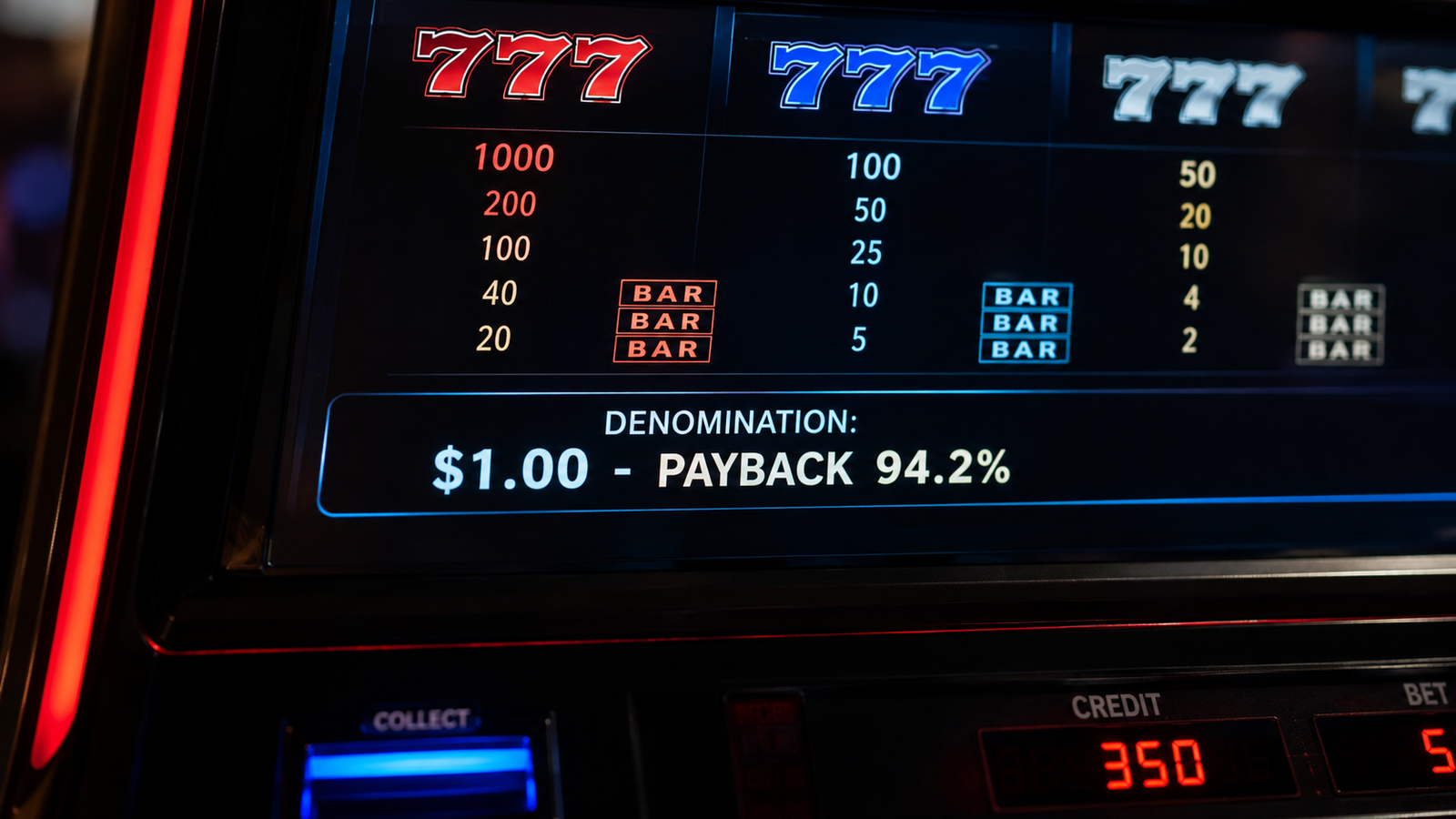
Direct Answer: Yes, higher denomination slots mathematically pay better. According to audited Nevada Gaming Control Board data, penny slots ($0.01) return an average of 88.5% to 89.5% RTP (a ~11% house edge), while dollar slots ($1.00) return 93.5% to 94.5% RTP, and $5 slots return 95.5%+ RTP. Casinos program higher payback percentages on larger denominations because higher total coin-in generates substantial dollar profit despite a lower house edge.
Walk into any casino from the Las Vegas Strip to Atlantic City, and you will notice a striking contrast: penny slots are packed with flashing lights, loud sound effects, and crowded chairs, while the high-limit slot salon is whisper-quiet.
Most casual players assume the only difference between a 1¢ slot and a $1 slot is how fast your balance moves. In reality, the underlying mathematical architecture—specifically the programmed Return to Player (RTP)—is drastically different.
1. The Official Gaming Commission Data: Payback by Denomination
While individual slot payback settings are proprietary trade secrets between slot manufacturers and casino operators, state gaming regulators publish aggregated, audited revenue reports.
The table below reflects multi-year audited averages compiled by the Nevada Gaming Control Board (NGCB) across Clark County casinos:
| Coin Denomination | Average Casino Hold (House Edge) | Player Payback (RTP) | Average Loss Per $100 Wagered |
|---|---|---|---|
| 1 Cent ($0.01 - Penny Slots) | 11.20% | 88.80% | $11.20 (Worst in Casino) |
| 5 Cents ($0.05 - Nickel Slots) | 8.45% | 91.55% | $8.45 |
| 25 Cents ($0.25 - Quarter Slots) | 7.10% | 92.90% | $7.10 |
| $1.00 (Dollar Slots) | 5.85% | 94.15% | $5.85 |
| $5.00 (Five-Dollar Slots) | 4.40% | 95.60% | $4.40 |
| $25.00+ (High Limit Rooms) | 3.20% | 96.80% | $3.20 (Best Slot Odds) |
DATA SOURCE: NEVADA GAMING CONTROL BOARD (NGCB) CLARK COUNTY GAMING REVENUE SUMMARY • VERIFIED INDEPENDENT AUDIT
The Takeaway: Moving from a 1¢ machine to a $1 machine cuts the casino's mathematical advantage almost in half (from ~11.2% down to ~5.8%).
2. The $3 Bet Dilemma: $3 on a 1¢ Slot vs. $3 on a $1 Slot
A frequent debate among slot players is: "If I am wagering $3 per spin, is it better to bet 300 credits on a 1¢ machine or 3 credits on a $1 machine?"
Wagering the identical dollar amount produces vastly different mathematical outcomes:
| Comparison Factor | $3 Bet on a 1¢ Slot (300 Credits) | $3 Bet on a $1 Slot (3 Credits) |
|---|---|---|
| Programmed RTP | ~88.8% (Lower) | ~94.2% (Higher) |
| Active Paylines | 30 to 50 Paylines | 1 to 3 Paylines |
| Hit Frequency | High (~30% - 35%) | Low (~10% - 15%) |
| Losses Disguised as Wins (LDWs) | Frequent (e.g., bet $3, win $0.80) | None (Minimum hit pays 1x or more) |
| Payout Potential | Small, frequent trickles | Substantial multipliers on hit lines |
The "Loss Disguised as a Win" (LDW) Effect
Penny machines cover up their terrible 88% RTP by giving you constant small hits across 40 paylines. When you bet $3.00 and the machine celebrates with lights and music for winning $0.90, your brain registers a "win," but your bankroll suffered a net loss of -$2.10.
On a $1 machine playing 3 credits, you either miss entirely or trigger a payout that actually exceeds your wager.
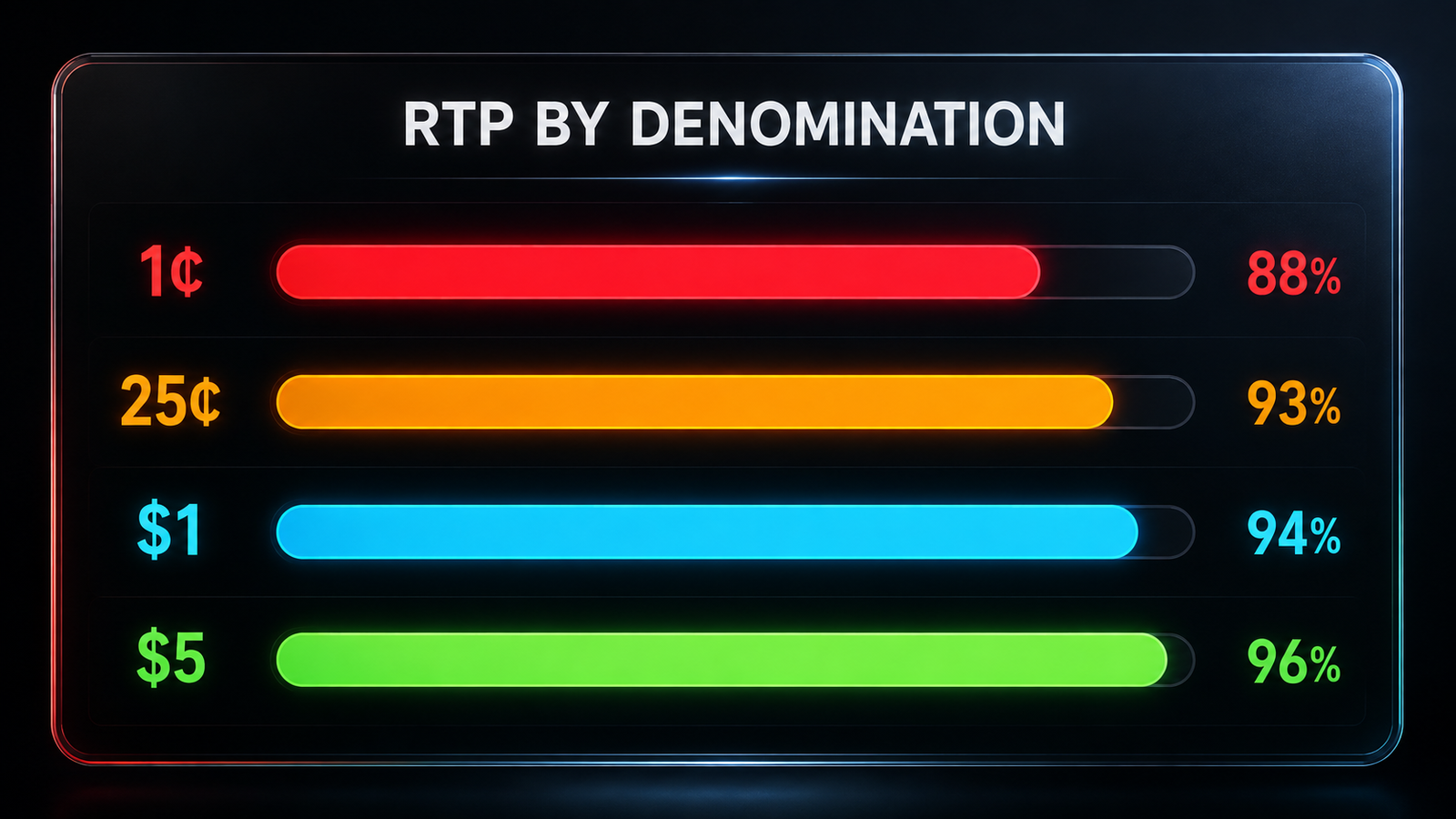
3. Do Multi-Denomination Slots Change RTP When You Switch?
Modern video slots like Dragon Link, Lightning Link, and Buffalo Gold allow players to select their denomination (1¢, 2¢, 5¢, 10¢, $1, $2) directly on the glass.
Do the odds change when you tap a higher denomination on the same terminal?
Yes. Slot manufacturers build multiple PAR sheets (Probability Accounting Reports) into the machine's software. In the casino management backend, operators can assign different payback profiles to different denomination tiers:
- 1¢ and 2¢ settings: Configured to the casino's lowest return tier (typically 88%–90%).
- 10¢, $1, and $2 settings: Configured to a higher return tier (typically 92%–94%).
Even on the exact same cabinet, selecting a higher denomination unlocks a more favorable math table.
4. The Hourly Loss Paradox: Why Higher RTP Can Still Cost You More
Before moving to higher denomination slots, you must understand the Total Dollar Turnover Formula:
Expected Hourly Loss = (Spins Per Hour × Bet Size) × House EdgeAssuming a standard pace of 500 spins per hour:
- Casual Penny Bettor: Betting $0.75 per spin on an 88% machine ($375 wagered/hr) loses an expected $45.00 per hour.
- High Denom Bettor: Betting $5.00 per spin on a 95% machine ($2,500 wagered/hr) loses an expected $125.00 per hour.
Even though the $5 machine gives back 7% more in long-term percentage, the sheer volume of cash pushed through the reels means your bankroll will evaporate much faster during a cold streak.
To put this mathematical tax into perspective, even the best $5 slot machine (with a 4.4% house edge) carries nearly eight times more statistical bleed than a standard 3:2 blackjack table (0.58% edge) or a player-favorable double-deck blackjack game (0.40% edge).
5. Checklist: When Should You Play Higher Denominations?
- Your Bet Size is Already $2+: If you are already wagering $2 to $5 per spin on penny games, switch to a $1 or $2 denomination immediately to capture the 5%–6% higher RTP.
- You Have a Sizable Bankroll: Higher denomination machines have lower hit frequencies; you need at least 150–200 betting units to withstand standard variance.
- You Prefer Clean Payouts Over Distractions: Higher denominations strip away low-value bonus animations in exchange for legitimate math value.
Frequently Asked Questions
Why do casinos give penny slots the worst odds?
Penny slots occupy the same expensive floor space, power, and capital cost as high-limit slots. Because casual players bet smaller amounts, casinos must set a higher house edge (11%–12%) to generate their required profit per square foot.
Does betting max coins increase the payout percentage?
On traditional 3-reel mechanical slots, yes—betting max coins often unlocks a disproportionately larger jackpot payout on top symbols, which raises overall RTP by 1% to 2%. On modern video slots, payouts scale proportionally.
Are high-limit slot rooms actually worth it?
Mathematically, yes. High-limit rooms ($5, $25, and $100 machines) feature the highest payback percentages in the casino (95% to 97%+). However, they require strict bankroll management due to high financial volatility.
Summary Key Takeaways
- State gaming commission data proves higher denomination slots feature significantly higher programmed RTPs (88% on pennies vs. 94%–96% on dollars).
- If you are already betting $2 to $5 per spin, playing penny machines costs you an extra 5% to 6% in pure house edge.
- Always maintain adequate bankroll padding when moving up in denomination to survive lower hit frequencies.