
Direct Answer: Mathematically, no—the Martingale system does not work in roulette. While it produces frequent small wins in the short term, it does not alter the casino's fixed mathematical house edge (2.70% on European wheels or 5.26% on American wheels). Because bet sizes scale geometrically ($5, $10, $20, $40, $80, $160, $320, $640, $1,280), a standard streak of 7 to 9 consecutive losses will either wipe out your bankroll or collide with the casino's table maximum limit.
The Martingale is the most famous betting system in casino history. Originating in 18th-century France, its premise seems foolproof to beginners: place an even-money bet on Red or Black, and every time you lose, double your wager on the next spin.
When you eventually win, you recover all previous losses plus a profit of exactly your original base unit ($5).
However, behind this seductive psychological illusion lies a brutal mathematical reality known in probability theory as The Gambler's Ruin. Here is why the math collapses in practice.
1. The Exponential Doubling Trap: 9-Step Progression
The fatal flaw of the Martingale is geometric progression ($2^n$). Bet sizes do not grow linearly; they explode exponentially.
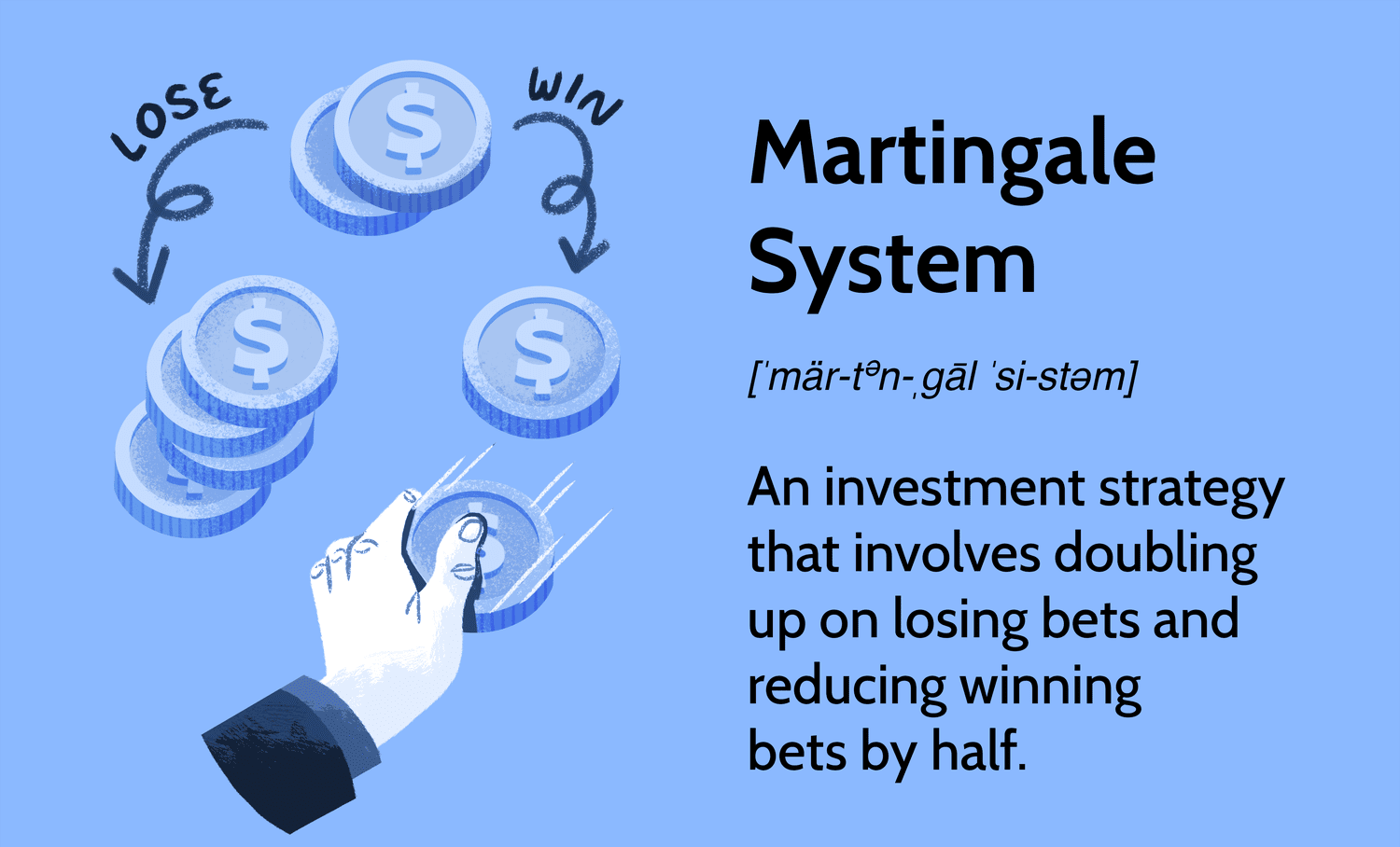
The table below illustrates a standard Martingale sequence starting with a modest $5 base bet on an even-money European roulette wheel (where the probability of losing a spin is 19/37, or 51.35%):
| Loss Step | Required Bet Size | Total Cumulative Risk | Net Profit on Win | Probability of Losing Streak |
|---|---|---|---|---|
| 1st Spin | $5 | $5 | +$5 | 51.35% |
| 2nd Spin | $10 | $15 | +$5 | 26.37% |
| 3rd Spin | $20 | $35 | +$5 | 13.54% |
| 4th Spin | $40 | $75 | +$5 | 6.95% |
| 5th Spin | $80 | $155 | +$5 | 3.57% |
| 6th Spin | $160 | $315 | +$5 | 1.83% |
| 7th Spin | $320 | $635 | +$5 | 0.94% |
| 8th Spin | $640 | $1,275 | +$5 | 0.48% (1 in 208) |
| 9th Spin | $1,280 | $2,555 | +$5 | 0.25% (TABLE LIMIT HIT) |
The Asymmetric Risk: Notice what happens by Step 8. To win a measly $5 profit, you must risk a cumulative $1,275 of your own money.
2. The Two Unbreakable Walls: Table Limits & Bankroll
Every Martingale strategy inevitably collides with two immovable real-world barriers:
Wall #1: Casino Table Maximum Limits
Casinos do not set table limits to be polite; they enforce them specifically to neutralize negative progression systems like the Martingale.
A standard roulette table with a $5 minimum bet typically has a $500 to $1,000 maximum bet for even-money wagers. Once you reach Step 8 ($640) or Step 9 ($1,280), the dealer will physically refuse your bet. At that moment, the progression is severed, and you lock in a devastating four-figure loss.

Wall #2: The Probability of Long Losing Streaks
Many players believe a streak of 8 or 9 consecutive losses (e.g., 9 consecutive Blacks when betting Red) is "impossible."
Mathematically, a 9-loss streak on a European wheel occurs with a probability of:
(19 / 37)^9 = 0.00248 (approximately 1 in every 403 sequences)In a standard casino session where a roulette wheel spins 40 to 50 times per hour, a 9-loss anomaly will reliably occur every few days of regular play. When it happens, it wipes out weeks of tiny $5 profits in a single spin.
3. The "Streak Hunter" Fallacy (Why Waiting Doesn't Work)
A common variation discussed by players on Reddit is "streak hunting"—waiting until Red has landed 5 or 6 times in a row before stepping in to bet on Black.
Under the Law of Independent Trials, this strategy provides zero mathematical advantage:
- While the cumulative probability of 7 consecutive Reds occurring from the start is low (~0.94%), once 6 Reds have already landed, the probability of the 7th spin landing on Red is still exactly 51.35% (on European wheels) or 52.63% (on American wheels).
- The roulette wheel has no memory. The ball cannot "know" that Red has landed repeatedly, and it is under no physical obligation to balance out short-term variance.
4. The Mathematical Proof: Why House Edge Never Changes
According to probability theory, the Expected Value ($E[X]$) of any series of bets is simply the sum of each individual bet's expected value:
E[Total] = E[Bet 1] + E[Bet 2] + ... + E[Bet n]Because every individual spin on a European wheel carries a negative expected return of -2.70 cents per dollar wagered, compounding your wagers simply accelerates your total dollar loss.
As explored in our analysis of whether all roulette wheels are the same, playing on a Double-Zero (5.26%) or Triple-Zero (7.69%) wheel makes the Martingale fail even faster due to multiple green house pockets.
5. Martingale vs. Alternative Betting Systems
Recreational players often compare the Martingale to other popular progression strategies:
- Reverse Martingale (Paroli): Instead of doubling after a loss, you double after a win (positive progression). This caps your maximum loss to 1 base unit while attempting to ride hot winning streaks.
- D'Alembert System: Increases bets by 1 unit after a loss and decreases by 1 unit after a win. The variance is much lower, but it still fails to beat the house edge.
- Fibonacci System: Follows the sequence (1, 1, 2, 3, 5, 8, 13...). Less aggressive than the Martingale, but still vulnerable to table limit caps during prolonged drawdowns.
Frequently Asked Questions
How many consecutive losses break a Martingale system?
On a typical $5 minimum table with a $1,000 maximum limit, a streak of just 8 consecutive losses will break the system. Doubling from $5 reaches $640 on the 8th loss, making the required 9th bet of $1,280 physically impossible to place.
Can you beat roulette with the Martingale system if you have infinite money?
In pure theoretical mathematics with no table limits and infinite capital, you would eventually win one unit. However, in reality, every casino enforces strict table maximum limits specifically to eliminate this theoretical loophole.
Does the Martingale work better on European roulette than American roulette?
The failure mechanism remains identical on both wheels, but the risk of a losing streak is slightly lower on European roulette (2.70% house edge) than American roulette (5.26% house edge) because European wheels contain only one green zero instead of two.
Why do casinos allow the Martingale system if it seems to win frequently?
Casinos welcome the Martingale system because it produces many small wins ($5) followed by occasional catastrophic losses ($1,275+). Over time, the house collects its exact mathematical edge on every dollar wagered.
Summary Key Takeaways
- The Martingale system cannot overcome the fixed house edge of roulette (2.70% European / 5.26% American).
- Bet sizes grow exponentially ($2^n$), forcing players to risk hundreds of dollars just to win a single $5 unit.
- Casino table maximum limits are specifically designed to stop Martingale doubling chains before you can recover losses.